Robbie Fulks & Linda Gail Lewis at The Green Room

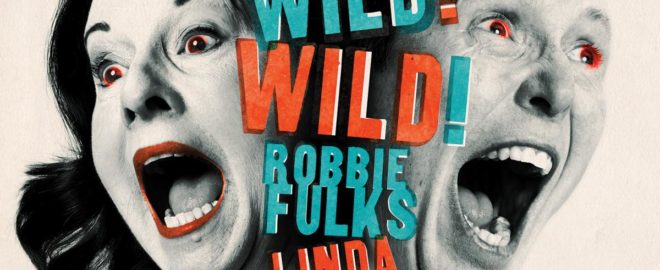
Join us in The Green Room at Crosstown Arts for a performance by roots rockers Linda Gail Lewis and Robbie Fulks.

Anyone who has been married nine times, almost died from substance abuse and, oh yeah, was a member of her wild-man older brother Jerry Lee Lewis’ band (with whom she sang duets) has some stories to tell. Linda Gail Lewis will be sharing her stories through song with vocal assistance of roots folk-rocker Robbie Fulks.

Tickets: $20
Doors 8:30 pm | Show at 9 pm

Linda Gail Lewis was born a Louisiana girl and now resides in Austin, Texas. She’s the little sister to living legend and musical genius, Jerry Lee Lewis. Raised on rock and roll-pumping piano and country, Linda Gail grew up with a passion for music. A professional musician since fifteen, she continues to tour sharing her high octane live show with music fans around the world.

Robbie Fulks is a singer, recording artist, instrumentalist, composer, and songwriter. His most recent release, 2017’s Upland Stories, earned year’s-best recognition from NPR and Rolling Stone among many others, as well as two Grammy® nominations, for folk album and American roots song (“Alabama At Night”).

In 1983, he moved to Chicago and joined Greg Cahill’s Special Consensus Bluegrass Band. He taught music at Old Town School of Folk Music from 1984 to 1996, and worked as a staff songwriter on Music Row in Nashville from 1993 to 1998. His early solo work — Country Love Songs (1996) and South Mouth (1997) — helped define the “alternative country” movement of the 1990s.

Radio: multiple appearances on WSM’s “Grand Ole Opry”; PRI’s “Whadd’ya Know”; NPR’s “Fresh Air,” “Mountain Stage,” and “World Cafe”; and the syndicated “Acoustic Cafe” and “Laura Ingraham Show.” TV: PBS’s Austin City Limits; NBC’s Today, Late Night with Conan O’Brien, Later with Carson Daly, and 30 Rock. From 2004 to 2008 he hosted an hourlong performance/interview program for XM satellite radio, “Robbie’s Secret Country.” Artists who have covered his songs include Sam Bush, Kelly Hogan, Andrew Bird, Mollie O’Brien, Rosie Flores, John Cowan, and Old 97s.

Robbie’s writing on music and life have appeared in GQ, Blender, the Chicago Reader, DaCapo Press’s Best Music Writing anthologies for 2001 and 2004, Amplified: Fiction from Leading Alt-Country, Indie Rock, Blues and Folk Musicians, and A Guitar and A Pen: Stories by Country Music’s Greatest Songwriters. As an instrumentalist, he has accompanied the Irish fiddle master Liz Carroll, the distinguished jazz violinist Jenny Scheinman, and the New Orleans pianist Dr. John. As a producer his credits include Touch My Heart: A Tribute to Johnny Paycheck (Sugar Hill, 2004) and Big Thinkin’ by Dallas Wayne (Hightone, 2000). Theatrical credits include “Woody Guthrie’s American Song” and Harry Chapin’s “Cottonpatch Gospel.” He served twice as judge for the Winfield National Flatpicking Guitar competition. He tours yearlong with various configurations.
The Lovelight Orchestra at The Green Room

Join us in The Green Room at Crosstown Arts for big band blues by The Love Light Orchestra.

Tickets: $10
Doors 7pm | Show at 7:30pm

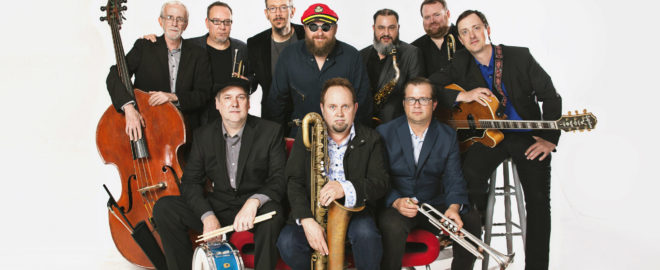
The Love Light Orchestra celebrates the Memphis big band blues-style found on the 1950s and ’60s singles of Bobby “Blue” Bland, B.B. King and Herman ”Junior” Parker. The band of seasoned Memphis musicians derives their name from Bland’s 1961 hit “Turn On Your Love Light.” Their sound is completed with the soulful voice of bluesman John Nemeth.

In addition to dipping into the catalogs of Buddy Ace, Freddie King, and Percy Mayfield, the band demonstrates their deftness with uptown blues via the solid originals “Singing For My Supper, “Lonesome and High,” and the Ray Charles-inspired opener “See Why I Love You.” Casual fans of Memphis music might only recognize their cover of Al Green’s iconic “Love and Happiness,” but it’s reset here as a shuffle, building upon riffs that horn player, Marc Franklin, says were inspired by Charles Mingus’ “Fables of Faubus.”

The Love Light Orchestra’s overall sound, says Franklin, was inspired by Joe Scott whose work Franklin discovered after he was hired to play with Bland in the early ‘90s. “The first time I heard his work, it sounded like Ellington, but more down-home with extended harmonics that you don’t necessarily hear on blues or soul records. It’s a jazz thing, throwing extra notes into the chords—at Stax they didn’t do 6th chords.”

Grammy-winning producer/engineer Matt Ross-Spang cut the record live at the tiny DKDC bar in Memphis, and recalls “it was more or less done after we cut it. This music is really supposed to be heard live, to be in the room to feel the horns, and it turned out magically — lightning in a bottle twelve times in just a couple hours.” — Scott Baretta, former editor of Living Blues

Princess: Out There at The Green Room

Join us at The Green Room at Crosstown Arts for performance art duo, Princess, which explores queerness and the concept of masculinity.

Tickets: $10
Doors 7 pm | Show at 7:30 pm

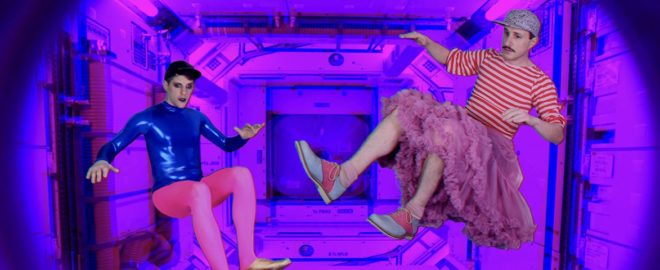
Princess is a performance art duo, a collaboration between Alexis Gideon and Michael O’Neill, that uses music as the backbone of a multi-disciplinary practice. Princess explores queerness and the concept of masculinity. Simultaneously gay, straight, queer, masculine, and feminine, Princess embodies the fluidity and coherence between the seemingly contradictory. Princess was formed in 2004 in the Chicago DIY Performance space Texas Ballroom. The duo released a self-titled LP and performed until 2006 when they went on to pursue other paths, reuniting for this project in 2017.


Scott Sharrard & The Bo-Keys

Join us in The Green Room at Crosstown Arts for a performance by blues guitarist and singer-songwriter Scott Sherrard and Memphis-based soul band, The Bo-Keys.

Tickets: $10
Doors 7:30 pm | Show at 8 pm

“One of the best guitarists in the country.” — Billboard Magazine

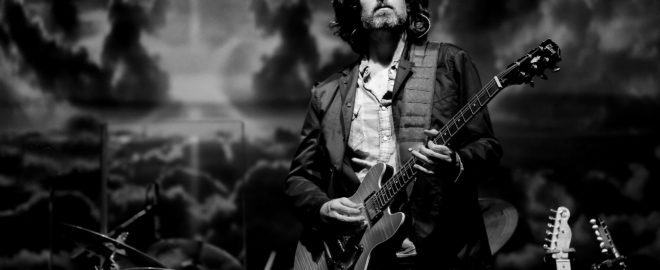
Scott Sharrard is best-known as lead guitarist and bandleader for the late Gregg Allman. But his personal artistic journey – which includes singing, songwriting, producing, and arranging – began long before he first teamed up with the rock icon.

“Gregg had a pure passion and heart,” Sharrard says of his friend, “especially when it came to being a musician. That authenticity and dedication is a daily inspiration, and I will always carry that with me onstage and in the studio.”

His latest record,“Saving Grace,” with the blues at its core, bears a distinctly southern spirit. Sessions took place in Memphis and at the historic FAME Studios in Muscle Shoals, Alabama. Half the album employs the Hi Rhythm Section, the other The Swampers of Muscle Shoals.

The partnership with Allman ended with the 69-year-old’s death on May 27, 2017. But not before Allman covered Sharrard’s “Love Like Kerosene” on 2015’s “Gregg Allman Live: Back to Macon, GA,” and again on Allman’s eighth and final solo album, the posthumous, GRAMMY-nominated “Southern Blood” (Rounder Records, 2017).

Another “Southern Blood” track, the unforgettable farewell “My Only True Friend” – co-written by Sharrard and Allman – earned a GRAMMY nomination for Americana Song of the Year.

He’s now begun a new chapter with an album he consciously wanted to summarize the last 20 years of his work – and one that showcases the totality of his artistry: as guitarist, singer, songwriter, producer, arranger and bandleader.

In short, he says, it’s rock n’ roll rooted in everything else.

“I basically have a rock ’n’ roll band,” Sharrard explains. “When I was growing up, I loved bands like Little Feat, Led Zeppelin and the Allmans. They would explore so many styles and experiment. That’s something I have always tried to embrace, and that’s how I want to present my music today. This is what I tried to do with Gregg. Now I’m continuing that as a solo artist.”

John Raymond & Real Feels at The Green Room

Join us in The Green Room at Crosstown Arts for a performance by up-and-coming jazz trumpeter and flugelhorn player John Raymond.

Tickets: $10
Doors 7 pm | Show at 7:30 pm

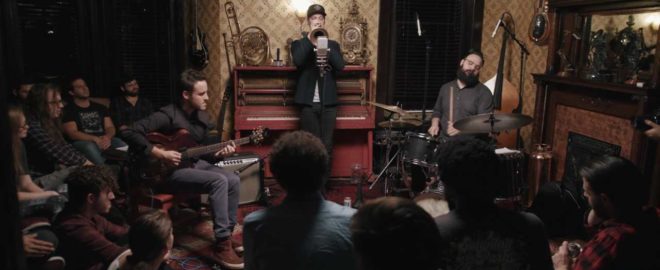
With a singular voice on the trumpet and flugelhorn, John Raymond is making his mark as one of the most promising, up-and-coming jazz musicians in the world. Recently dubbed as a Rising Star by Downbeat Magazine, John has performed with some of most well-respected names in jazz, including Orrin Evans, Kurt Rosenwinkel, Billy Hart, and Linda Oh among others. He has released five albums under his own name since 2012, all of which are receiving critical acclaim from the New York Times, Stereogum, Downbeat, JazzTimes, and more. John has also established himself as a sought-after educator, both as the Professor of Jazz Trumpet at Indiana University and as a guest clinician and soloist at schools around the world.

Raymond’s Real Feels is a bass-less trio that includes Gilad Hekselman (guitar) and Colin Stranahan (drums), and the leader on flugelhorn. Together, they incorporate indie-rock, folk, and electronic influences to both riveting original music and fresh takes on recognizable songs by artists such as Bob Dylan, Thom Yorke, Bon Iver, Paul Simon and more. Regardless of material, the band’s improvisational, free-wheeling, “keep-you-on-the-edge-of-your-seat” approach to the music makes each experience with Real Feels a new and captivating experience. It’s no surprise that they are one of the hottest, up-and-coming groups in jazz today.


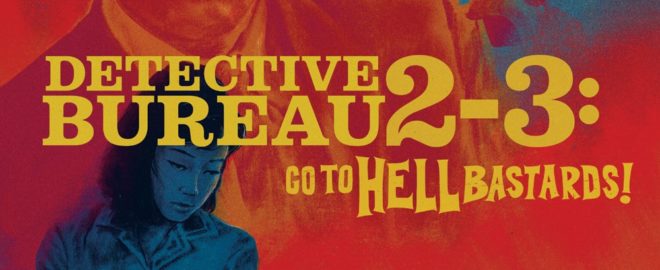
Live Score to Seijun Suzuki’s Detective Bureau 2-3: Go To Hell Bastards!

Memphis-based Detective Bureau presents a live score of Seijun Suzuki’s “Detective Bureau 2-3: Go To Hell Bastards!”

Detective Bureau explores late ’60s and early ’70s Afro-Brazilian soul jazz stylings. Featuring Joe Restivo (guitar), Marc Franklin (trumpet), Landon Moore (bass), Pat Fusco (keys), George Sluppick (drums), and Felix Hernandez (percussion).

Tickets: $10
Doors 7:30pm | Performance 8pm

Seijun Suzuki was a Japanese filmmaker, actor, and screenwriter. His films are known for their jarring visual style, irreverent humor, nihilistic cool, and entertainment-over-logic sensibility. He made 40 predominately B-movies for the Nikkatsu Company between 1956 and 1967, working most prolifically in the yakuza genre. His increasingly surreal style began to draw the ire of the studio in 1963 and culminated in his ultimate dismissal for what is now regarded as his magnum opus, Branded to Kill (1967).